
Why ALOCS Jorts Is Popular Premium Cotton Feel
The graphic is the lead, not the outfit
The usual approach is to fix on a silhouette and hang the pieces off it. Because the graphic arrives first, I do the reverse with That’s A Awful Lot Of Cough Syrup. The label’s own copy will not stop repeating a single construction on tees and hoodies: jumbo screen prints www.awfullottacoughsyrup.com/product-category/shorts at front and back. This is not a little chest hit that disappears under a jacket. The artwork is sized to be read across a room, with the wordmark usually doing the job of the artwork. You are not deciding what goes with black cotton, the question is what goes with a sentence printed twice at full volume. The remainder sorts itself out once that order is settled.
Four honest starting pieces
The loudest piece comes first, and everything else builds down from it. That one decision sets the volume, and it beats balancing two statements afterwards. How a piece hangs is decided by weight, so the published specs matter more than any lookbook. At the brand’s own store as of September 2026, the classic tees run 6.5 oz organic cotton in a relaxed fit at roughly $150 while the classic hoodie runs 16 oz organic cotton at about $200, and the sweatpants a 14 oz fleece for the same money. Streetwear prices shift constantly, so read those as a snapshot. Garment facts here come from the brand and the opinions are clearly mine, over the four pieces people own first.
Start from the tee
Nothing is an easier way in than cough syrup shirts, and nothing is easier to get slightly wrong. A relaxed cut in 6.5 oz organic cotton is what the classic tee is, with jumbo screen prints front and back, a yellow woven label at the hem, and a fit published as true to size. Loose-fit Dickies pants in the brand’s 65/35 cotton-polyester blend, or the denim cargo shorts when it is warm, are the quiet and roomy answer. Let the tee be the only thing talking, so leave the printed sweatpants for another day. A relaxed tee over a narrow trouser reads as accident, which is why I would avoid a slim tapered leg. The hem is where the label sits, so I would skip tucking it too. Two of the lightweight jersey tees are published as running small, and the brand suggests one to two sizes bigger.
Starting from the hoodie
The weight of it is why the awful lot of cough syrup hoodie counts as a different animal. Being 16 oz organic cotton, hand-dyed and printed in Los Angeles, it holds a shape of its own and will not drape over anything bulky underneath. Logos at the chest and across the back, the yellow woven label at the wearer’s bottom left and a fit described as true to size make up the brand’s published detail. Put a flat, simple bottom half under it and let the back print work: carpenter pants, Dickies pants, or denim shorts in transitional weather. The back graphic is half of what you paid for, so a puffer over the top is out. Skip stacking it over a printed tee, since two jumbo prints fight rather than layer. If the outfit is already busy, the black tonal version gives you the logo without the shouting.
Starting from the cargo shorts
Alocs shorts go in several directions, though the denim pair has real construction to work with. The Double Cup Cargo Shorts come in mid-rise 14 oz denim, garment-dyed by a double dye process the brand says mimics sun-fading, with double cup pockets at the back, cargo pockets at the side and a custom leather patch. Look at the published inseams first: 7.75 inches on small through 9.5 on 2XL, with waists from 28 to 44. The brand says to size up one for an oversized fit, while they otherwise fit true to size. Hold the colour simple, since the shorts come in grey, black and green, purple and red, and put a plain heavyweight tee on top, or the Dickies button down worn open. Avoid a second cargo-pocket piece, because side pockets stop reading as a detail once they are everywhere. The shorts vanish entirely under a top that hangs below the hem, so avoid that.
Lead with the sweatpants
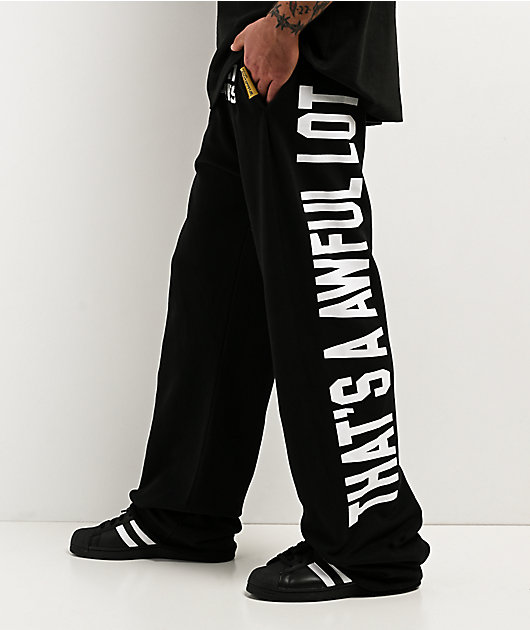
The classic sweatpants are made up as a 14 oz fleece published as 80 percent cotton and 20 percent recycled polyester. Printed across the front and up the back legs, the logo carries the detail people miss: the print runs vertically, so these are a graphic garment, not a neutral base. Flare cuts sit alongside the straight ones, and they fit true to size. Let the leg print do the work by pairing them with a plain tee or a tonal hoodie. Because both prints sit at roughly the same height and cancel out, do not put a jumbo-print tee over them. If you want a set, matching Athletic Dept. pieces are on offer, and I have no objection, as long as you accept that a set is a uniform.
Balancing the loud graphic
One loud thing per outfit is my working rule, and everything else earns its place by staying quiet. The yellow woven label does real work on an otherwise plain hem, and black and yellow are described as the brand’s signature colours. A second focal point only splits the one the outfit already has, once the graphic is the wordmark printed large. Tonal pieces work as the pressure valve, so a black tonal hoodie lets you wear awful lot of cough syrup gear without the outfit being about the slogan. Colour is the other lever, from grey and purple on the denim to ice blue elsewhere, so you can pitch the volume before the print is considered. Accessories pick up what attention is left, since a bandana near $25 adds brand presence for less than another printed garment. Worth knowing is that the name references promethazine-codeine cough syrup, known as lean, and the graphics draw on medical and horror imagery accordingly.
Fit on fit, and getting the proportion right
Whether alocs clothing looks considered or looks random turns on proportion. The lightweight jersey tees run 20 inches wide by 17.5 long on small, 21.5 by 19 on medium and 23 by 20.5 on large, and those published measurements say more than any campaign image. A wide, short body is what those numbers describe, which is a different shape from the relaxed classic tee and wants a different bottom half. A wide-and-short top sits happiest over length and volume, so full-length loose pants rather than shorts. Heavy pieces behave the opposite way, since a 16 oz hoodie has structure already and needs no voluminous leg competing with it. With inseams of 7.75 to 9.5 inches, the denim shorts sit short by current standards, which pushes the balance upward and makes a boxier top read correctly. Fit guidance appears per product, with true to size as the default, some styles inviting you to size up, and a couple running small.
The short version: piece by piece
A table compresses everything above, and it is the version I would text a friend. On the left is the piece you start from, in the middle what I would put with it, on the right what I would leave in the closet. Not one line of it is a rule. The garment details come from the brand’s published specifications; the opinions about what clashes are mine. One hard decision per outfit is what starting from one piece gives you. Every drop shifts availability, which is why the catalogue is worth checking first.
| Starting piece | What it pairs with | What to avoid |
|---|---|---|
| The relaxed 6.5 oz tee | Loose Dickies pants, carpenter pants and denim shorts | Tapered legs, printed sweatpants and tucking |
| 16 oz cotton hoodie | Carpenter pants, Dickies pants or denim shorts | A puffer over the back print, a second jumbo print |
| The Double Cup Cargo Shorts | Plain heavyweight tee, Dickies button down left open | A second cargo-pocket piece, a top below the hem |
| The 14 oz fleece sweatpants | Plain tee, tonal hoodie or a matching Athletic Dept. top | A jumbo-print tee over the leg print |
| The Dickies button down, 65/35 | Open over a printed tee, plus shorts or loose pants | Fastening it over the graphic you wanted to show |
Before the next purchase
Every opinion above is outranked by two practical things. Fit instructions live on the product page, and that is the first of them, because there is no global chart and the guidance differs between styles. Second comes the yellow woven label, named at the hem on tees and at the wearer’s bottom left on the hoodie, checkable alongside the published fabric weights and real price levels. There is the brand’s own online store, and there are locations on Melrose Avenue and West 5th Street in Los Angeles and Almeda Road in Houston. In September 2026 prices sat near $150 for a tee and $200 for a hoodie, though those numbers keep moving. One piece to build from, the second-loudest thing kept quiet, and fabric weight left to do the rest.